
Acupuncture for Fibromyalgia
Fibromyalgia is a chronic condition of widespread musculoskeletal pain combined with fatigue, unrefreshing sleep, and cognitive symptoms often called “fibro fog.” Because it affects the whole body rather than one spot, treatment in our clinic is whole-body too. Acupuncture may help make these symptoms more manageable and may support better overall quality of life, alongside your medical care — not as a replacement. Individual results may vary.
What is fibromyalgia?
In fibromyalgia, the nervous system processes pain differently — a feature researchers call central sensitization. The “volume” on pain signals is effectively turned up, so ordinary sensations can be felt as painful. This is a real, measurable change in how pain is processed — fibromyalgia is not “all in your head.” There is no single blood test or scan; it is diagnosed by a pattern: widespread pain lasting three months or more, alongside fatigue, sleep problems, and cognitive symptoms.
Common symptoms
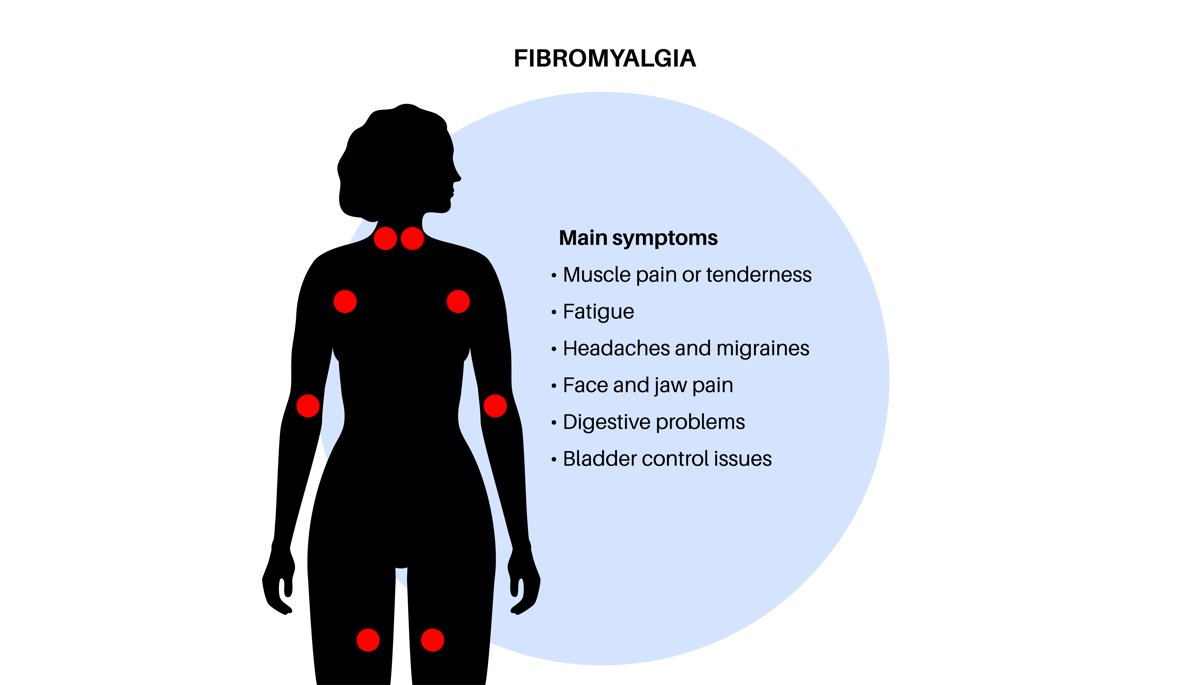
Fibromyalgia rarely travels alone. Many of its overlapping symptoms have their own dedicated approach on this site:
- Widespread pain — aching on both sides of the body, above and below the waist
- Fatigue & low energy — persistent exhaustion; see chronic fatigue
- Poor, unrefreshing sleep — waking tired; see insomnia & sleep
- “Fibro fog” — trouble with focus, memory, and word-finding
- Mood changes — anxiety and low mood; see stress & anxiety
- Digestive issues — bloating and irregularity; overlaps with IBS
- Headaches — tension headaches and migraines
- Jaw & facial pain — often overlaps with TMJ & jaw tension
- Bladder & urinary urgency — increased urgency or discomfort can accompany fibromyalgia
- Symptom flares — often worse with stress, weather, or around menopause
What contributes to fibromyalgia?
The exact cause is unknown, but several factors are associated with higher risk:
| Risk factor | Notes |
|---|---|
| Female sex | Markedly more common in women (Wolfe et al., 1995) |
| Middle age | Most often diagnosed in middle age; prevalence rises with age (CDC) |
| Family history | Tends to run in families |
| Other rheumatic conditions | e.g. rheumatoid arthritis, lupus |
| Physical or emotional trauma | Injury, illness, or major stress can precede onset |
In TCM (Traditional Chinese Medicine), the pattern behind fibromyalgia is often understood as developing from a combination of factors working together — inadequate or unbalanced nutrition, too little physical activity, and prolonged or heightened stress. Over time these are seen to disrupt the smooth flow of Qi (the body's vital energy) and to deplete the body's reserves, which TCM links to widespread pain, fatigue, and unrefreshing sleep. This is why treatment is whole-body, and why we also encourage supportive everyday changes — nourishing food, gentle regular movement, and stress reduction — alongside acupuncture rather than relying on needling alone.
How acupuncture may help
Acupuncture does not cure fibromyalgia — no treatment does — but it may help in several ways that fit the whole-body nature of the condition:
| Mechanism (may help) | What patients are working toward |
|---|---|
| Modulating how pain is processed | Easing the amplified pain of central sensitization |
| Supporting sleep quality | More restful sleep, which itself reduces pain sensitivity |
| Calming stress & autonomic arousal | A steadier, less wound-up nervous system |
| Strengthening Qi & overall vitality | A renewed sense of energy and well-being — feeling more like yourself again |
| Working alongside medication & exercise | May enhance their effect (Cochrane, 2013) |
Beyond easing specific symptoms, treatment in Chinese medicine aims to strengthen the body's Qi (its vital energy). Many patients report a renewed sense of vitality and overall well-being — in their own words, simply feeling more alive and more like themselves again. Individual results may vary.
Research on acupuncture for fibromyalgia
A 2013 Cochrane systematic review (Deare et al., Cochrane Database of Systematic Reviews, CD007070) pooled nine randomized trials involving 395 people. It found low-to-moderate-quality evidence that electroacupuncture probably reduces pain and stiffness and improves sleep, fatigue, and overall well-being in the short term; that acupuncture appears safe; and that it may enhance the effect of medication and exercise. Manual needling alone showed weaker effects, and benefits were short-term — pointing to a continued, individualized course of care. As always, acupuncture is offered as a complementary approach alongside your medical care, not as a replacement. Individual results may vary.
Our approach
Treatment is whole-body — we needle across the body, not only where it hurts, using distal points to help calm the over-sensitized nervous system while also supporting energy and sleep. The approach draws on advanced acupuncture techniques, including Master Tung's Acupuncture and Dr. Tan's Balance Method, tailored to each patient. The aim is not only symptom relief but a better day-to-day quality of life. For fibromyalgia overall we favor gentle manual needling; if you have a specific area of pain, electroacupuncture may be used there where appropriate. Individual results may vary.
Acupuncture works best as part of an integrative plan. We're glad to coordinate with your physician, rheumatologist, or physical therapist — combining care often supports better outcomes than any one approach alone.
What to expect
Sessions are performed lying down in whatever position is most comfortable. During the first four sessions we'll see how your body is responding; most patients should notice some improvement within that window. From there we set the plan and the number of sessions together — this varies from patient to patient depending on how long symptoms have been present and how quickly you progress. Treatment typically begins twice weekly, then eases to once weekly and every two weeks as you improve, with an optional monthly maintenance session to help hold your results. Individual results may vary.
Fibromyalgia is diagnosed by a pattern of symptoms, so it's important to rule out other conditions. Seek medical evaluation for new or changing symptoms such as fever, unexplained weight loss, joint swelling or redness, or new neurological changes (weakness, numbness). Acupuncture complements — and does not replace — care from your physician.
Frequently Asked Questions
No treatment currently cures fibromyalgia. Acupuncture may help make symptoms such as pain, sleep, and fatigue more manageable and may support overall quality of life. Individual results may vary.
Treatment is gentle, and our whole-body approach lets us work with points away from the most tender areas. In research, acupuncture for fibromyalgia appears safe and is generally well tolerated (Deare et al., Cochrane, 2013).
We usually start with four sessions to assess how your body responds — most people notice some improvement in that window. From there we set the plan and number of sessions together, based on chronicity and your pace of progress.
For fibromyalgia as a whole-body condition, we favor gentle manual needling. If you have a specific area of pain, electroacupuncture may be used there where appropriate.
Yes — that is the point of the whole-body approach. Because poor sleep and fatigue feed the pain cycle, we address them alongside pain. See our pages on insomnia and chronic fatigue.
Yes. Acupuncture is complementary and may enhance the effect of medication and exercise (Deare et al., Cochrane, 2013). We coordinate with your medical care and never advise stopping prescribed treatment.
We are a self-pay practice and do not bill insurance directly. Upon request, we can provide a superbill — an itemized receipt with the codes insurers require — which you may submit for possible out-of-network reimbursement, depending on your plan. Acupuncture is also an eligible expense for most HSA and FSA accounts.