
Acupuncture for Trigeminal Neuralgia
Trigeminal neuralgia is often described as one of the most severe pains a person can experience — sudden, electric-shock-like jolts through the cheek, jaw, or around the eye, sometimes triggered by something as light as a breeze, a touch, brushing teeth, or chewing. Living with it can be exhausting and isolating. For patients seeking options beyond medication — or seeking support alongside it — acupuncture is one approach that some find helpful for managing this difficult condition. Individual results may vary.
Trigeminal neuralgia should be diagnosed and managed by a physician, ideally a neurologist, as it can sometimes be related to underlying conditions that need medical investigation. Acupuncture is used as a complementary approach alongside — not instead of — appropriate medical care. Always keep your medical team informed.
What is trigeminal neuralgia?
Trigeminal neuralgia (also called tic douloureux) is a chronic pain condition affecting the trigeminal nerve — the fifth cranial nerve, which carries sensation from the face to the brain. It has three branches that supply different zones of the face: the ophthalmic (around the eye and forehead), maxillary (cheek), and mandibular (jaw). When this nerve misfires, it produces sudden, intense bursts of facial pain. The condition is often caused by a blood vessel pressing on the nerve, though other causes exist.
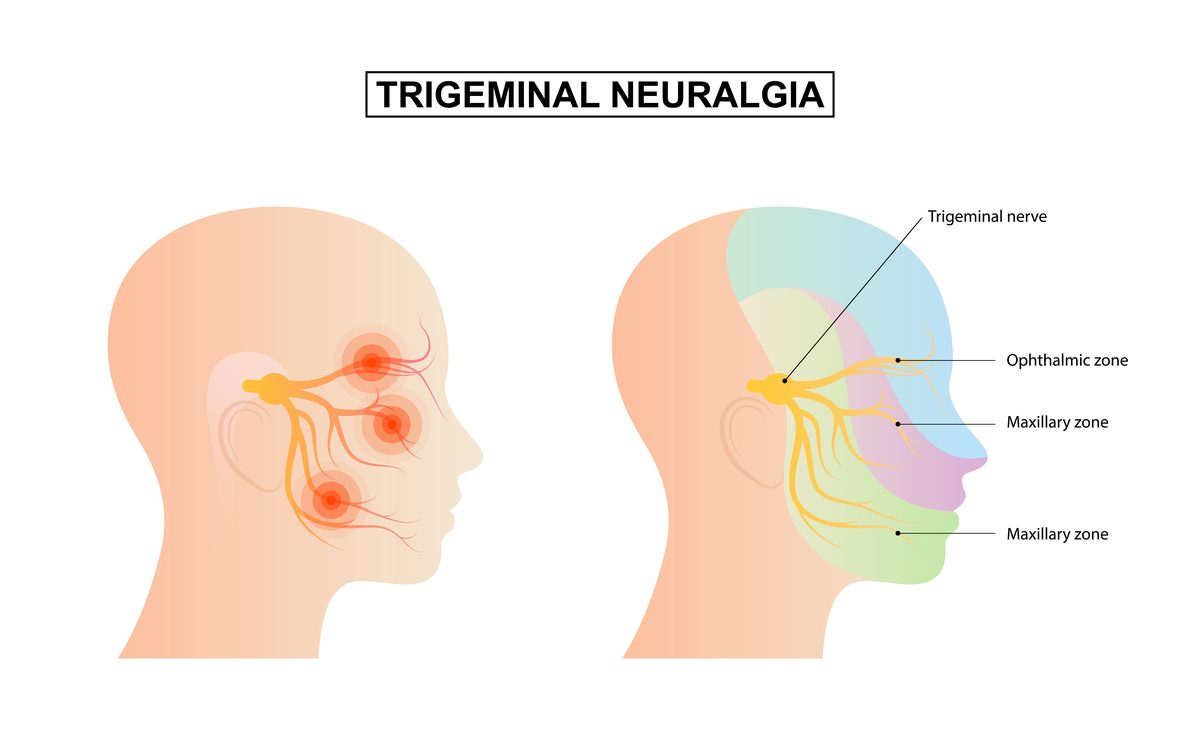
Symptoms
Brief but intense jolts of pain on one side of the face, lasting seconds to a couple of minutes, often in the cheek or jaw.
Everyday actions — chewing, talking, brushing teeth, washing the face, or even a light breeze — can set off an attack.
Attacks may come in waves over days or weeks, sometimes followed by periods of remission. The unpredictability is part of what makes it so difficult.
How acupuncture may help
Research into acupuncture for trigeminal neuralgia is still developing. It is used as a complementary approach that may help through several mechanisms:
| Benefit | Mechanism |
|---|---|
| Pain modulation | May influence how pain signals from the trigeminal nerve are processed |
| Endorphin release | Stimulates the body's own pain-relieving chemistry |
| Reduced nerve excitability | May help calm the over-excited nerve signaling involved in attacks |
| Stress & tension support | Pain flares are exhausting; treatment also supports the nervous system overall |
A systematic review and meta-analysis suggested acupuncture may be as effective as carbamazepine (a standard medication) for some patients with trigeminal neuralgia, with fewer reported side effects — though the authors noted the need for higher-quality trials (Liu H. et al., Journal of Pain Research, 2019). Evidence remains limited and not conclusive. Individual results may vary.
Our approach
Treatment uses advanced acupuncture techniques alongside classical Traditional Chinese Medicine (TCM) and gentle electroacupuncture when appropriate. Importantly, because the face can be highly sensitive and trigger-prone in trigeminal neuralgia, treatment often emphasizes distal points — on the hands, arms, and legs — to influence the facial nerve without aggravating sensitive trigger zones. The approach is always gentle and tailored to your tolerance. Individual results may vary.
What to expect
Treatment is typically recommended twice weekly at first. I use the first 4 sessions as a clinical assessment — most patients have a sense of whether the approach is helping within this period. Because trigeminal neuralgia is a chronic condition that can flare, ongoing maintenance treatment is often part of a long-term management plan, always in coordination with your medical care.
Frequently Asked Questions
Acupuncture is not presented as a cure. It is a complementary approach that some patients find helpful for managing the pain and reducing how much attacks affect daily life, often alongside medication or other medical treatment. Results vary considerably from person to person. Individual results may vary.
This is a common and understandable concern. Because the face can be extremely trigger-sensitive in trigeminal neuralgia, treatment often focuses on distal points away from the face — on the hands, arms, and legs — to work with the nerve without provoking it. Any facial points, if used at all, are approached with great care and only with your comfort in mind.
Yes. Acupuncture is generally used as a complement to medical care, not a replacement. Many patients continue their prescribed medication while adding acupuncture for additional support. Always keep your neurologist informed about all the treatments you're using.
Trigeminal neuralgia is a nerve-pain condition, distinct from jaw-joint problems (TMJ) or dental pain — though they can feel similar and are sometimes confused. Accurate diagnosis by a physician or dentist is important, since the treatment approaches differ. We're happy to work as part of your broader care team.
We are a self-pay practice and do not bill insurance directly. Upon request, we can provide a superbill — an itemized receipt with the codes insurers require — which you may submit to your insurance company for possible out-of-network reimbursement, depending on your plan. Acupuncture is also an eligible expense for most HSA and FSA accounts. Contact us with questions.
Related Conditions & Services
Sources: National Institute of Neurological Disorders and Stroke (NINDS/NIH) — trigeminal neuralgia incidence and demographics; Liu H. et al., "Acupuncture for trigeminal neuralgia: a systematic review and meta-analysis," Journal of Pain Research, 2019.