

Acupuncture for Tennis Elbow & Golfer's Elbow
Tennis elbow (lateral epicondylitis) and golfer's elbow (medial epicondylitis) are two sides of the same problem — an overuse tendinopathy where the forearm tendons meet the elbow. The pain can be surprisingly stubborn: gripping a coffee mug, turning a doorknob, or shaking hands can become a daily reminder. Acupuncture may help by easing tendon irritation, relaxing the overworked forearm...
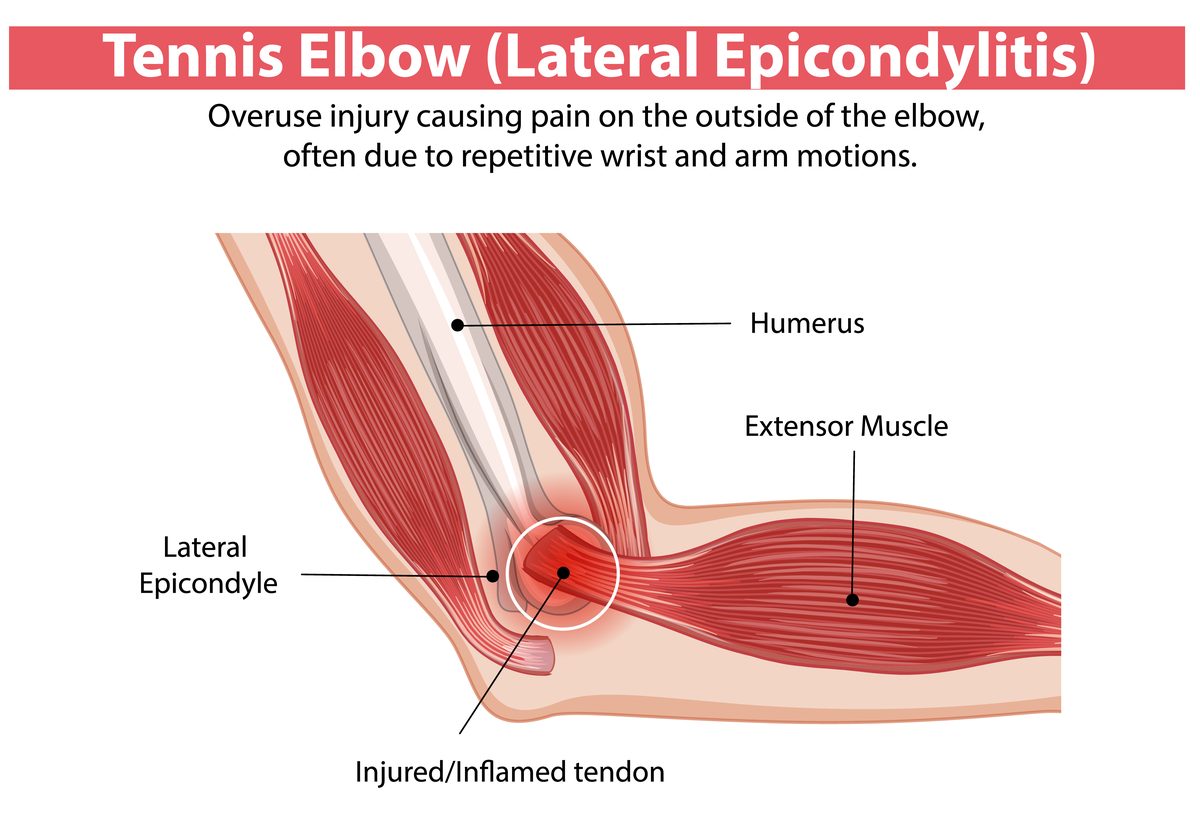
What is tennis elbow?
Despite the name, you don't have to play tennis to get it — in fact, only about 1 in 10 cases actually come from playing tennis. Most cases come from everyday repetitive gripping and wrist movements: trade work, typing, lifting, gardening, or any task that repeatedly strains the muscles that straighten the wrist and fingers. Those muscles share a common anchor point — the bony bump on the outer elbow called the lateral epicondyle. Small strains build up faster than the tendon can repair, and the tendon (especially the extensor carpi radialis brevis) becomes painful and tender.
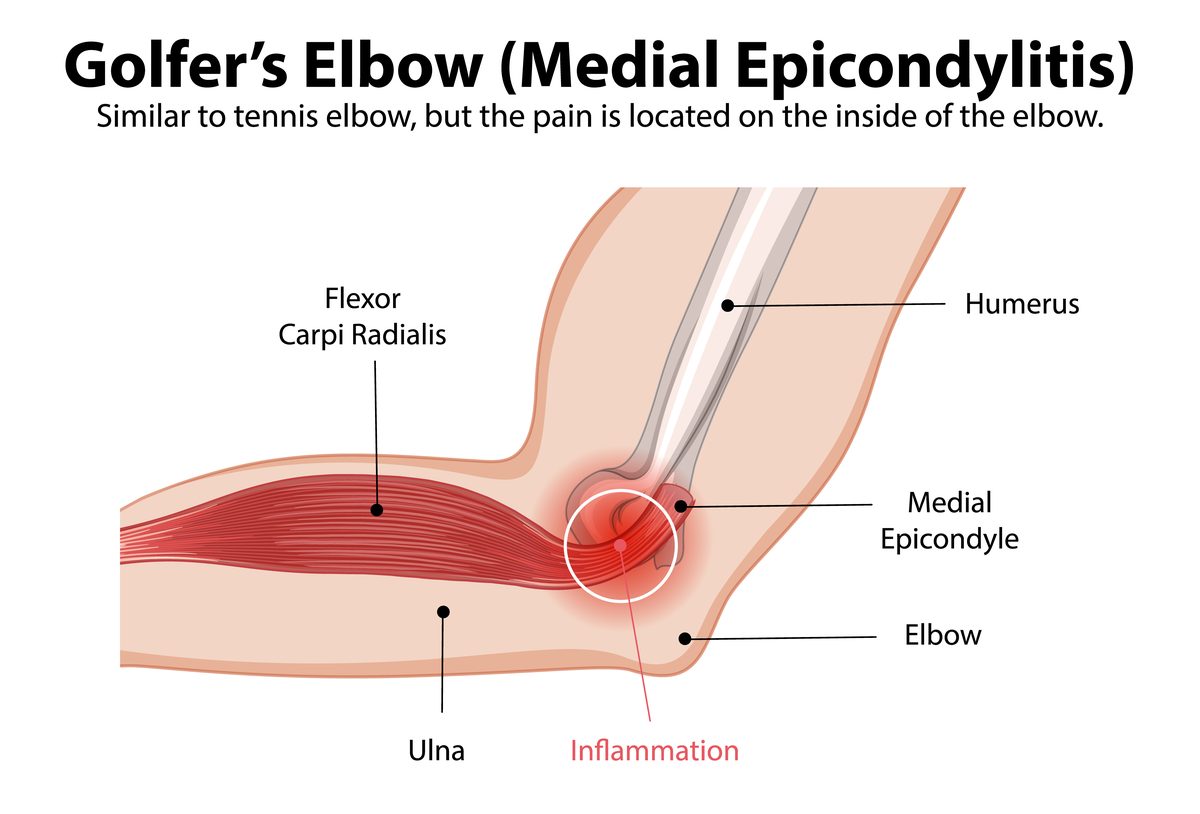
Golfer's elbow — the same problem on the inner side
Golfer's elbow (medial epicondylitis) is the mirror image: it affects the tendons on the inner side of the elbow — the muscles that flex the wrist and grip. It's noticeably less common than tennis elbow (affecting roughly 0.4% of adults vs. tennis elbow's 1–3%) and, like its counterpart, it's usually driven by repetitive gripping, lifting, throwing, or wrist-flexing work rather than golf alone. The acupuncture strategy is the same — the needle locations simply shift to the inner side of the elbow — which is why both are covered here on one page.
Common symptoms
On the outer elbow for tennis elbow, the inner elbow for golfer's elbow — often tender to the touch right at the bump.
Shaking hands, turning a key, lifting a kettle or a bag of groceries, or holding a tool can trigger a sharp or aching pain that radiates into the forearm.
Many patients notice their grip "gives out," along with morning stiffness and a forearm that feels tight or fatigued.
Common causes & risk factors
Tennis and golfer's elbow usually build up gradually from a combination of factors rather than a single injury:
| Risk factor | How it contributes |
|---|---|
| Repetitive gripping & wrist motion | Trade work, typing, assembly, racquet/throwing sports — micro-strains the tendon faster than it can repair |
| Age 35–54 | Tendons lose some elasticity and blood supply with age, the peak window for both conditions |
| Forceful or sustained loading | Heavy lifting and forceful gripping, especially combined with repetition, raise the risk substantially |
| Smoking | Identified across population studies as an independent risk factor for elbow tendinopathy |
| Technique & equipment (sport) | Poor backhand mechanics or an ill-fitted racquet/club concentrate load on the tendon origin |
How acupuncture may help
| Mechanism | What patients may notice |
|---|---|
| Supporting the tendon's natural repair | Tennis and golfer's elbow are now understood to be more a tendon-wear (degeneration) problem than a purely inflammatory one — part of why anti-inflammatory medication doesn't always help. Acupuncture may help by stimulating local circulation and the body's own repair response in a tendon that is normally slow to heal |
| Easing irritation & any local inflammation | In the earlier, more irritated phase there can be a local inflammatory component; acupuncture may help settle tenderness around the tendon |
| Relaxing the forearm muscles | Reduced pull on the tendon origin and a looser, less fatigued forearm |
| Calming the pain response | Many patients report the pain becoming more manageable over a course of care |
A 2020 systematic review and meta-analysis of 10 randomized controlled trials (796 patients) reported that acupuncture produced a higher total effective rate and greater reduction in pain scores for lateral epicondylitis compared with sham acupuncture, medication, and injection therapy (Zhou et al., Pain Research and Management, 2020). An earlier Cochrane review (Green et al., 2002) found acupuncture may give short-term pain relief but called for higher-quality trials — so the evidence is encouraging while still developing. Individual results may vary.
Our approach — local and distal needling
Treatment uses advanced acupuncture techniques (including the Master Tung and Balance Method systems) alongside classical Traditional Chinese Medicine (TCM), with electroacupuncture added when indicated. I treat both locally — at and around the affected elbow tendon — and distally, using points on the forearm and on the opposite limb (a Balance Method mirror approach) to influence the painful elbow with minimal needling of the most irritated spot. Because elbow tendon pain is often linked to tension further up the arm, treatment may also address the shoulder and neck when relevant. This same approach extends to other repetitive-strain and sports injuries, and to nerve-related arm complaints such as carpal tunnel syndrome. Individual results may vary.
Many patients come to acupuncture after anti-inflammatory medication, bracing, or a cortisone injection hasn't given them the relief they had hoped for. In my experience, some find acupuncture a helpful next step as part of a conservative, drug-free plan. Individual results may vary.
What to expect
Treatment is typically recommended twice weekly at first. During the first four sessions we'll see whether your body is responding; from there we set the plan and the number of sessions together, which varies from person to person depending on how long you've had the problem and how quickly it improves. As things settle, visits taper to weekly, then biweekly, with monthly maintenance if your work keeps loading the tendon. Individual results may vary.
See a physician if your elbow pain follows a fall or direct blow, if there is significant swelling, bruising, locking, or instability, or if you have numbness or tingling running into the hand (which can point to nerve involvement rather than a tendon problem). Acupuncture is best suited to overuse tendinopathy and works well alongside medical care, not as a replacement for it.
Sources: Shiri R. et al., "Prevalence and Determinants of Lateral and Medial Epicondylitis: A Population Study," American Journal of Epidemiology, 2006 (prevalence: lateral 1.3%, medial 0.4%; risk factors); eMedicine/Medscape — Lateral Epicondylitis (annual incidence 1–3%, age range, and tendinosis/degenerative pathology of the extensor origin); "Lateral and Medial Epicondylitis," MOJ Orthopedics & Rheumatology (MedCrave), 2015 (~10% tennis-related; age 35–54); Zhou Z. et al., "Effectiveness of Acupuncture for Lateral Epicondylitis: A Systematic Review and Meta-Analysis of Randomized Controlled Trials," Pain Research and Management, 2020; Green S. et al., "Acupuncture for lateral elbow pain," Cochrane Database of Systematic Reviews, 2002.
What the research says
Tennis elbow (lateral epicondylitis) and golfer's elbow (medial epicondylitis) have been examined in multiple controlled trials, with acupuncture showing consistent short-term benefits.
- Systematic review: Trinh et al. (Rheumatology, 2004) found strong evidence for acupuncture's short-term effectiveness in relieving lateral epicondyle pain compared to sham control.
- Acupuncture vs. corticosteroid injection: A randomized trial (Fink et al., Rheumatology, 2002) found acupuncture significantly superior to sham for tennis elbow pain at 2-week and 2-month follow-up, with responder rates comparable to corticosteroid injection without the tissue side effects.
- Dry needling component: Trigger-point needling of the forearm extensor muscles — which is part of our approach — has specific evidence for reducing myofascial pain and improving grip strength in lateral epicondylitis. (Eftekharsadat et al., Journal of Physical Therapy Science, 2016). Individual results may vary.
Evidence supports short-term benefit; long-term outcomes depend on addressing the biomechanical cause. Individual results may vary.